Newsletter drafts · No. 08 / 20
What should our monthly AI search visibility scorecard contain?
Last updated
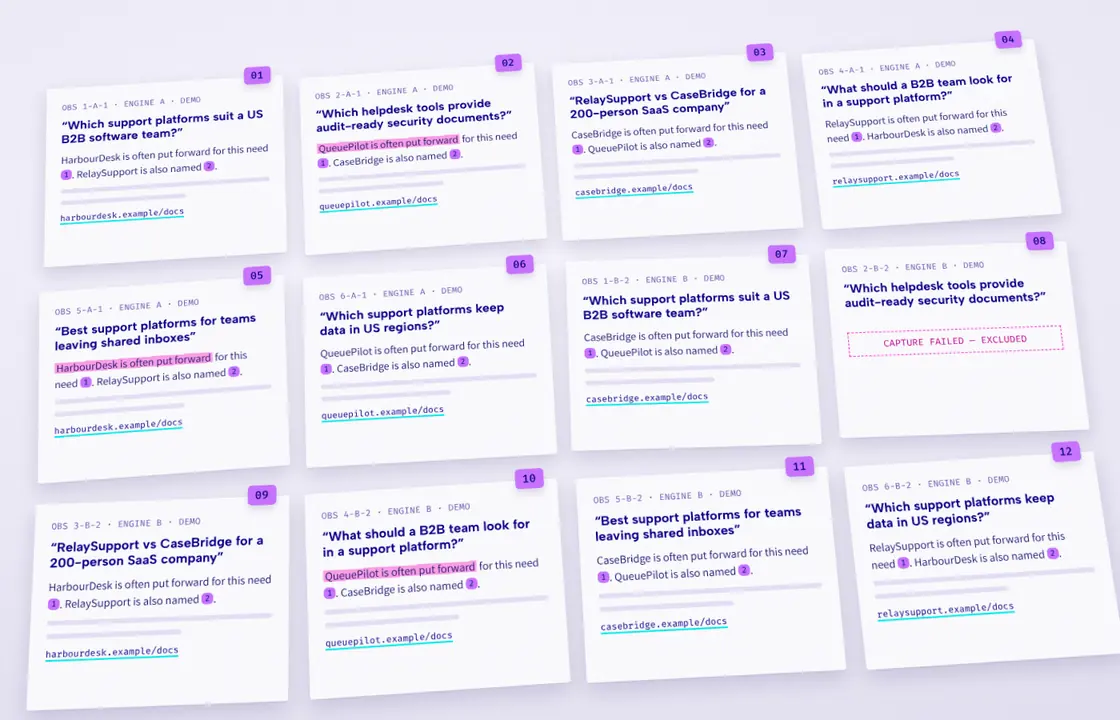
Use separate measures with explicit denominators. The following is our proposed reporting specification, not an industry-wide benchmark.
| Measure | Proposed definition | Decision it supports |
|---|---|---|
| Mention frequency | Successful sampled answers naming the brand ÷ successful sampled answers | Is the brand present in this test set? |
| Owned-domain citation frequency | Successful answers linking to the brand’s domain ÷ successful sampled answers | Is owned information being cited? |
| Recommendation frequency | Successful answers explicitly suggesting the brand as suitable ÷ successful sampled answers | Are we entering relevant shortlists? |
| Recommendation prompt coverage | Prompts receiving at least one recommendation ÷ successfully tested prompts | How broad is inclusion across tested questions? |
| Accuracy exceptions | Logged checkable claims contradicted by dated, approved evidence | What needs correction? |
| Commercial observations | Identified referrals, qualified enquiries and customer-reported AI discovery, reported separately | Is there evidence worth investigating beyond visibility? |
Report failures alongside the denominators. Define how an ambiguous recommendation is scored. Keep branded prompts separate from unbranded category discovery; do not describe either sample as total market share.
For share-of-voice reporting, specify whether the denominator is all answers, all brand mentions or mentions among selected competitors. Our preference is to show the underlying counts rather than hide them in a composite.