Scorecard · No. 14 / 17
How should you compare GEO pricing and total cost?
Last updated
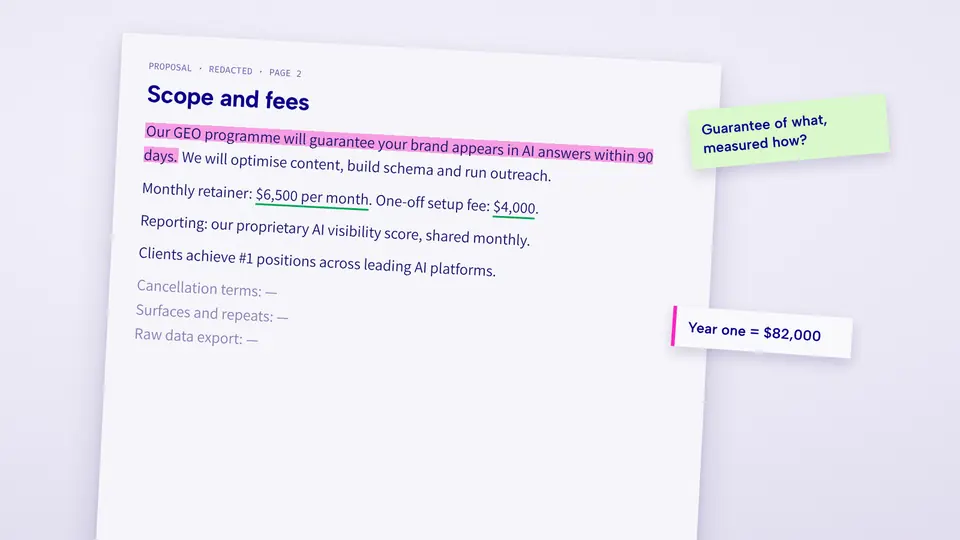
Price the operating arrangement, not just the subscription or retainer. Request separate lines for collection, analysis, implementation, integrations, internal time, quality review and exit.
Illustrative 90-day cost model—not a market quotation
| Cost item | Assumption | Pilot cost |
|---|---|---|
| Monitoring | $400 per month × 3 | $1,200 |
| Implementation support | $4,500 per month × 3 | $13,500 |
| Buyer staff time | 30 hours total × $100 fully loaded | $3,000 |
| One-off setup or independent QA | Assumed fixed amount | $1,500 |
| Total | $19,200 |
Replace every assumption with the buyer’s quote and internal cost estimate. Specify taxes, overages and contingency separately. This calculation is expenditure under review—not expected return or avoided revenue loss.
Ask procurement to resolve:
- Does a “prompt” include every selected engine, market and repeat?
- Are failed collections, retries and historical backfills billable?
- Are raw answers, API access and exports included in this package?
- Who owns the prompt library, commissioned content and configuration?
- What evidence can the buyer retain after cancellation, subject to relevant rights?
- What happens if a collection route stops working?
- Can scope or scoring definitions change without buyer approval?
- Are referral fees, sponsored placements or other incentives disclosed?
NIST’s generative AI profile recommends clear third-party contracts addressing ownership, usage rights, security, evaluation and continuity. Use those topics as procurement prompts, not as a claim that a vendor is “NIST certified”. (nvlpubs.nist.gov)
Sources cited on this page
- nvlpubs.nist.gov nvlpubs.nist.gov/nistpubs/ai/NIST.AI.600-1.pdf