Comparisons · No. 02 / 13
What should “AI visibility” measure?
Last updated
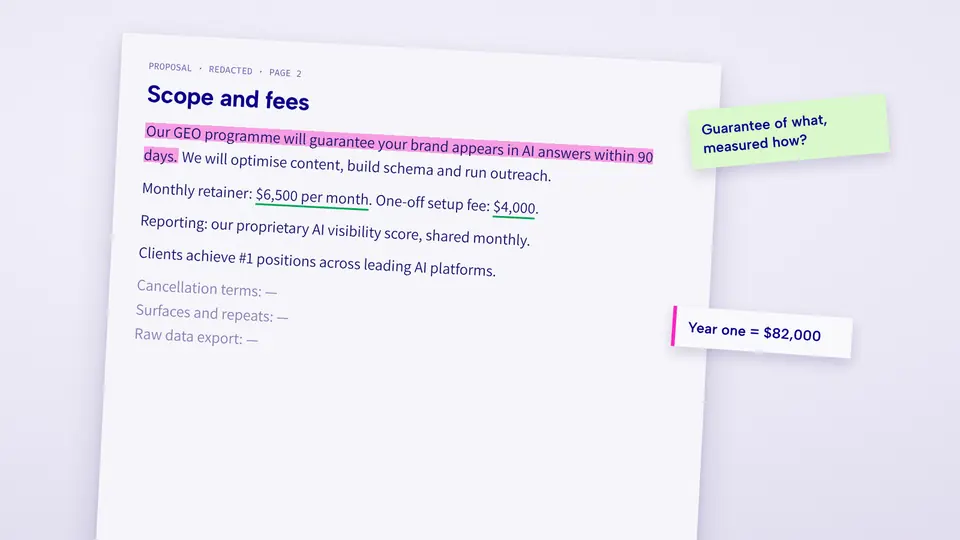
Require separate measures for mentions, citations and recommendations. For procurement, we propose the following operational definitions; a supplier may use different definitions, but must explain them.
| Measure | Proposed scoring rule | What it answers | What it does not establish |
|---|---|---|---|
| Brand mention | The answer names the correct company or product | Were we present? | Whether the answer endorsed us |
| Owned-page citation | A displayed source link points to an approved company-owned domain | Was our material linked? | Whether our product was recommended |
| Third-party citation involving the brand | A linked external page contains a verified reference to the brand | Which external sources appeared alongside the answer? | Whether that reference caused inclusion |
| Explicit recommendation | The answer presents the product as suitable for the stated need | Were we proposed as an option? | Whether a real buyer acted on it |
| Accuracy | Checkable statements agree with dated, approved product evidence | Were we represented correctly? | Whether every other statement is accurate |
| Commercial response | An observed referral, enquiry or customer-reported discovery event | Is there evidence beyond answer presence? | Incremental revenue caused by the programme |
Do not let a favourable sentiment label substitute for recommendation scoring. An answer can describe a company positively while recommending another supplier.
The denominator also matters. Microsoft explicitly distinguishes citation activity from ranking or placement in its AI Performance reporting. Ahrefs describes its modelled visibility estimates as potential visibility rather than actual audience reach. Neither should be silently relabelled as customer consideration or market share. (blogs.bing.com)
How should a prompt-share benchmark be calculated?
For a buyer-owned benchmark, we recommend reporting:
- Mention frequency: valid observations naming the brand ÷ valid observations in the disclosed test set.
- Recommendation frequency: valid observations recommending the brand ÷ valid observations in the relevant buying-question set.
- Owned-citation frequency: valid observations linking an owned page ÷ valid observations in the disclosed set.
- Collection completeness: successful observations ÷ planned observations.
- Accuracy exceptions: the actual disputed claims, their recurrence and the reference evidence—not just an average score.
A failed collection is unknown, not brand absence. A successfully observed Google result with no AI Overview is a valid non-trigger observation: report the AI Overview trigger rate separately, then make clear whether citation frequency uses all observed searches or only searches displaying an overview.
If you calculate competitive share, disclose the competitor universe. A brand’s share of recommendation events among five selected companies is not its share of all US AI-assisted buying journeys.
Sources cited on this page
- blogs.bing.com blogs.bing.com/webmaster/2026/2/Introducing-AI-Performance-in-Bing-Webmaster-Too