Next steps · No. 07 / 11
Stage 4: What should you ask before signing a GEO agency or monitoring contract?
Last updated
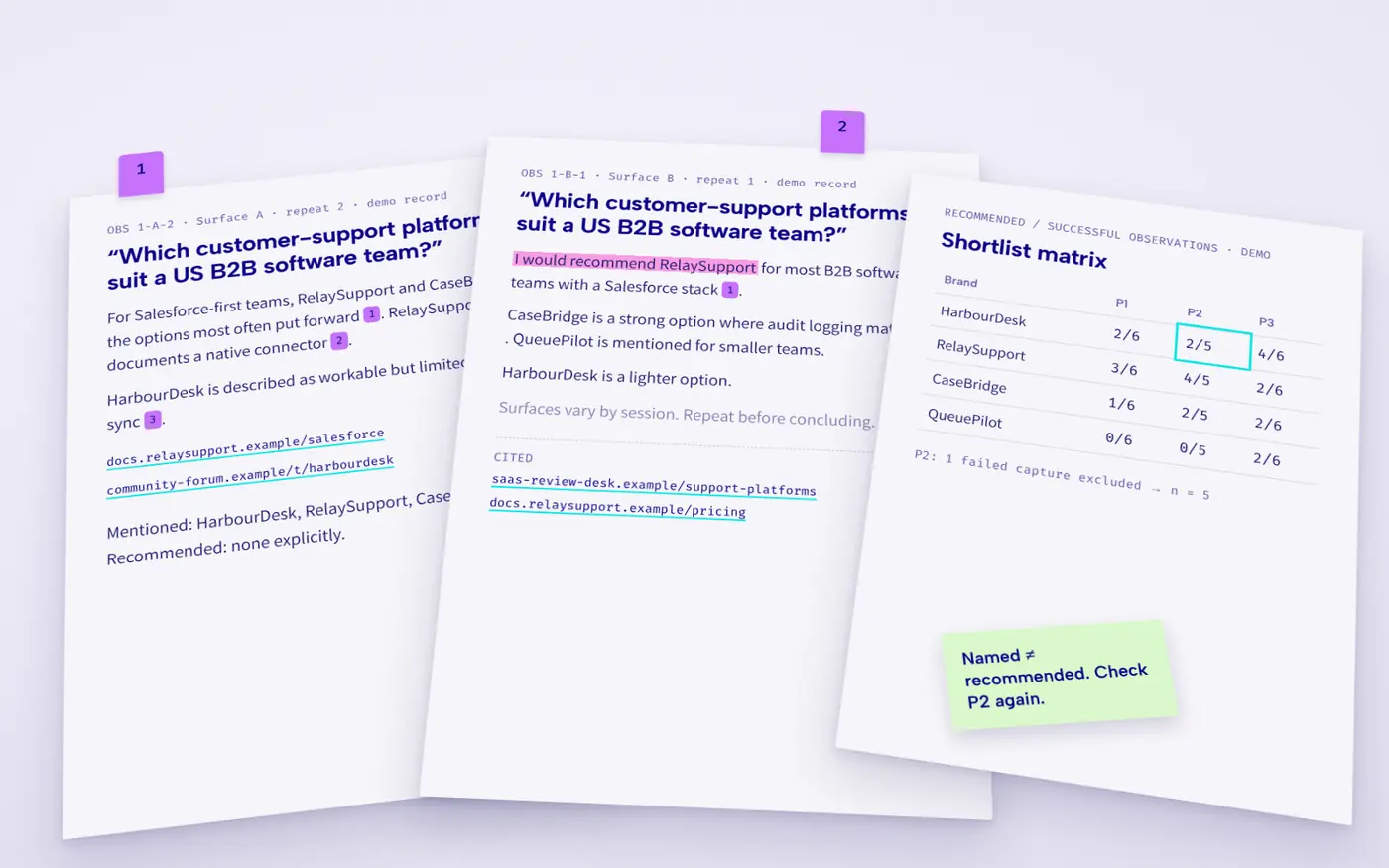
Give each supplier the same brief and ask for the same evidence. Do not compare a monitoring subscription with an implementation retainer as though they deliver the same outcome.
Procurement checklist
- Coverage: exact surfaces, access routes, countries, languages, prompts and refresh schedule.
- Definitions: separate mentions, recommendations, owned citations, external citations and accuracy.
- Collection quality: failed-run handling, retries, model changes and continuity arrangements.
- Evidence access: full answers, timestamps, URLs, historical exports and a sample export before purchase.
- Implementation: named deliverables, responsible people, approval dependencies and deployment responsibility.
- Validation: a frozen core benchmark, independent spot-checks and disclosed changes to scoring.
- Commercial terms: base fee, engine add-ons, overages, minimum term, renewal notice and cancellation.
- Exit: export format, access after cancellation, retention and deletion arrangements.
- Security: permitted data, subprocessors, access controls and incident responsibilities.
- Conflicts: referral payments, publisher ownership and any supplier involvement in supposedly independent evidence.
NIST’s generative AI risk profile supports documented third-party risk management and ownership of incident response. Use it as a diligence reference, not as a claim that a supplier has satisfied every applicable legal obligation. (nvlpubs.nist.gov)
Which promises or practices should trigger a pause?
Unexplained collection methods. OpenAI’s individual-service terms prohibit automated or programmatic extraction of data or output. Require suppliers to explain their applicable access arrangements; do not assume a technically functioning collection method is authorised. (openai.com)
Guaranteed performance without substantiation. Ask for the underlying evidence, exclusions and measurement rules. The FTC states that a money-back guarantee does not substitute for evidence supporting advertising claims. (ftc.gov)
Fabricated reviews or disguised independent endorsements. The FTC’s rule addresses fake reviews, sentiment-conditioned review incentives and misrepresentation of company-controlled review sites as independent. Reject these tactics rather than treating them as an aggressive optimisation option. (ftc.gov)
An intervention without a delivery owner. Put the publishing and approval responsibilities in the contract. An agency/vendor podcast published in February 2026 highlights resourcing and approval bottlenecks in AI-search work; that is useful practitioner context, not evidence of how common the problem is across buyers. (beomniscient.com)
Sources cited on this page
- nvlpubs.nist.gov nvlpubs.nist.gov/nistpubs/ai/NIST.AI.600-1.pdf?utm_source=openai
- openai.com openai.com/policies/terms-of-use/?utm_source=openai
- ftc.gov www.ftc.gov/business-guidance/resources/advertising-faqs-guide-small-business?ut
- ftc.gov www.ftc.gov/news-events/news/press-releases/2024/08/federal-trade-commission-ann
- beomniscient.com beomniscient.com/blog/ai-search-tactics-telemetry-and-team-structure/